
a recycled essay from a literature class I took last semester. :^)
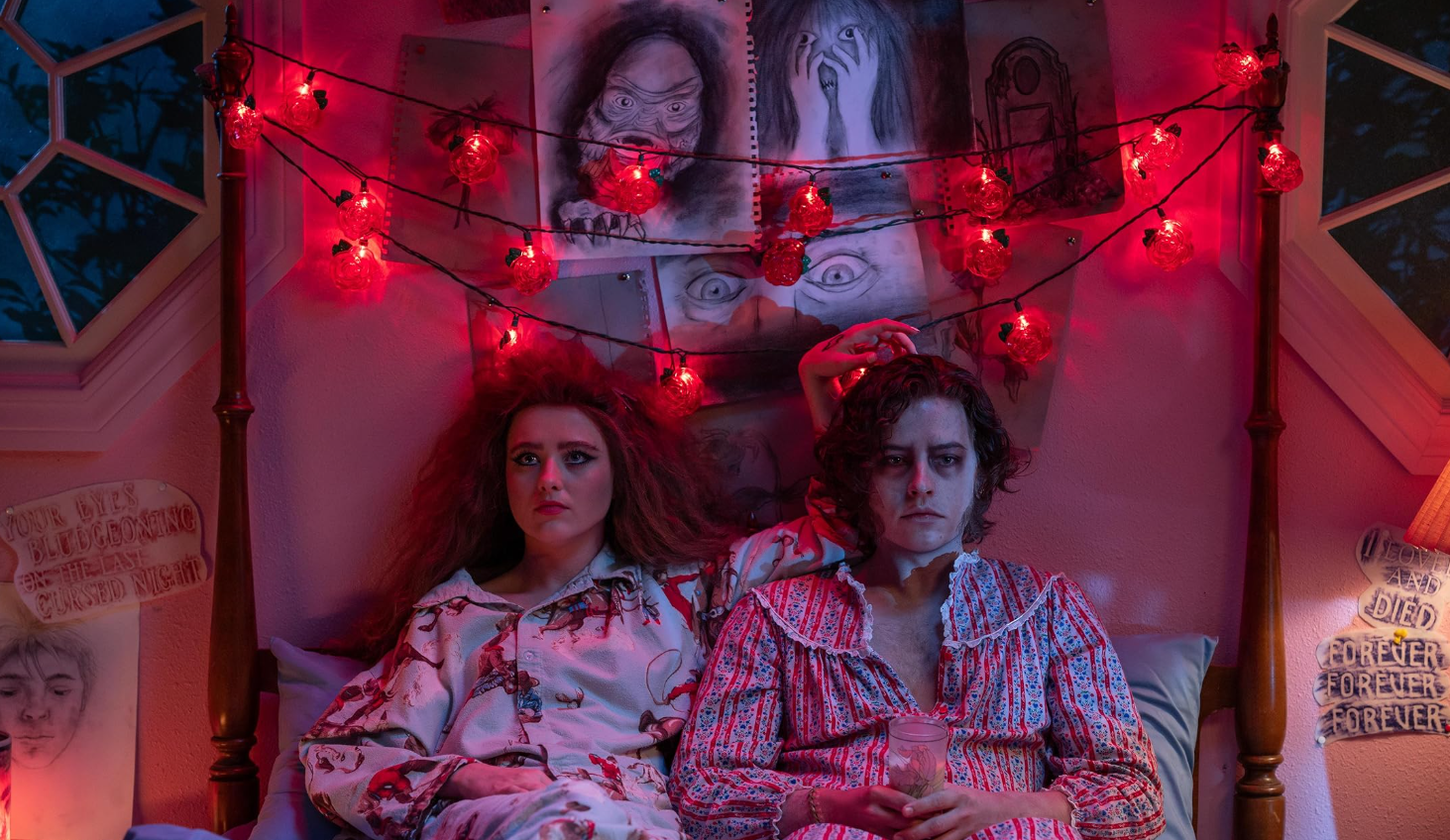
In Lisa Frankenstein (2024, dir. Zelda Williams), emotions are powerful conduits for tangible change, and dreams are spaces where we are able to regain lost power and envision ourselves the way we would like to be. Early in the movie, Lisa Swallows confides in a stone statue and experiences a surreal dream after being sexually assaulted by her classmate Doug. Through the imagery of the statue, references to Bride of Frankenstein (1935, dir. James Whale), and camera angles, this scene shows the two ways she sees herself: the damaged real-life version, and the empowered version in her dream.

At the beginning of the scene, Lisa walks through a cemetery while wandering home from the party where Doug assaulted her. She visits a tombstone decorated with the statue of a young man and admits to it that she wants to be “with [him],” that is, dead. (00:15:13) Lisa then arrives home, where she looks at her reflection in the bathroom mirror. She impulsively strikes and breaks the glass. At the same time, lightning strikes the statue, resurrecting the corpse beneath it. (00:15:43)

The film cuts quickly between these two events, creating a connection where Lisa’s anger at her assault is powerful enough to be compared to significant, reality-shifting change in her world. Lisa’s effect on the statue in the graveyard is reminiscent of the “stone of patience” image discussed by Maria Tatar in the second chapter of her book The Heroine with 1001 Faces.

Source: “Patience Stone and Patience Knife”, Internet Sacred Text Archive
Stones of patience are featured in folktales, perhaps most explicitly in the Persian tale “Sang-e Saboor”. Depending on the source material, these stones function as a stand-in listener for victims to confide in (often so that an eavesdropping sympathizer will overhear the person’s woes and become moved to help them) or the stone itself can be the sympathizer; as Tatar describes it, “a stone that can listen to human sorrows so intense that it feels empathy.” (38) In both cases, the stone allows an individual to express their true suffering because it seems as though no one is listening – the victim feels free to speak without being judged or silenced. Unlike the stones of patience in some of the folktales Tatar describes, the young man’s statue in Lisa Frankenstein does not swell and burst with empathy, but the effect of Lisa’s words lead to a similarly explosive phenomenon. In the film, her admission to the statue that she wants to die and her following emotional outburst are shown to be powerful enough to trigger life in a dead man.
The following shot is a close-up of Lisa’s reflection after she breaks the mirror, with the camera angle making the viewer see her as she sees herself, through a distorted perspective. (00:15:47) Lisa’s discomfort with seeing herself is emphasized through dark colors and a moment of silence as she looks at her altered reflection.

This representation of her broken self-image contrasts with how she appears and acts in the next moment, when she goes to her bedroom, blinks, and is transported into a surreal dream world. (00:16:07) When she sits up, her hair becomes visible, and the unique, tall styling of it – along with the scene changing from dark colors to soft grayscale – is a clear reference to the 1935 film Bride of Frankenstein. (00:16:35) The usage of the bride’s iconic appearance in this scene connects to Linda Hutcheon’s A Theory of Adaptation, where she describes “adaptation” as a process: “adaptation is a form of intertextuality: we experience adaptations (as adaptations) as palimpsests through our memory of other worlds that resonate through repetition with variation.” (Hutcheon 8)

Lisa Frankenstein is by no means a direct adaptation of Mary Shelley’s novel or of subsequent movie adaptations of her text, and it does not aim to be one. However, this specific scene can be looked at through Hutcheon’s concept of adaptation where aspects of previous media are repeated but altered to fit a new audience or message. There is an interesting reversal happening here. In the 1935 film, the bride is made purely as a companion for Frankenstein’s creature. In this scene, Lisa is in the position of the creator, not the creation, as was implied a moment earlier when she (albeit accidentally) resurrected the young man’s corpse. This creation-creator shift is strengthened later on, when she purposefully aids the Creature in finding new body parts. Using visual connections between her character and the bride, this scene subverts audience members’ potential preconceptions about that particular female character in popular culture. Similar to Hutcheon’s description of adaptation as a process of “(re-)interpretation and then (re-)creation,” (8) Lisa is able to create adaptations of herself in her dreams, to recreate and reimagine herself differently. The image of the bride of Frankenstein’s creature is also used as a representation of the more confident and empowered way that Lisa imagines herself in her dreams. This is shown mainly through a shift in body language: she appears more relaxed, and her facial expressions are more curious and open rather than the introverted and uncomfortable body language she displays earlier in the film.

Lisa’s dream being a space of self-empowerment can also be seen through her interactions with the young man’s statue, which appears in her dream. The statue sits at the foot of her bed, and she sits next to him – notably with their positions swapped from how Lisa and Doug were sitting when he assaulted her: in the dream, Lisa sits on the viewer’s right, where Doug was, and thus her dream physically moves her out of the place of vulnerability and into a position of power. (00:17:03)


In her dream, we also see a version of intimacy without an ulterior motive. The statue opens his hand and offers her a pack of chewing gum, but instead she takes his hand and holds it. (00:17:15) This moment reinforces her having more confidence and control in the dream as it shows her being the one to decide to initiate physical contact. It also contrasts her earlier experience with the classmate who assaulted her; in that scene, he offered her a hand to help her stand up after she became intoxicated at a party, (:00:12:14) but that interaction quickly goes south. In Lisa’s dream, she has agency in how the interaction plays out. The camera angles in this scene also help to show that the characters are on equal footing: Lisa and the statue are shown in a wide angle, in identical lighting and at equal height with one another. (00:17:04) In other words, the camera treats them the same, and neither figure is framed as predatory or vulnerable.
Zelda Williams’ film uses the settings of a dark outer world and a dream world to contrast how Lisa views herself post-assault with the empowered, self-assured version of herself that she becomes in her dream. The reference to Bride of Frankenstein allows viewers to see the character of the bride from a different perspective, allowing us to revisit and reframe a character who was originally presented with very little power over herself or her life. Lisa taking on the appearance of the bride reverses this original representation, allowing her to step into a more empowered persona. In this way, the dream sequence in Lisa Frankenstein presents dreams and adaptation as ways that we can reimagine female characters – and ourselves – and find power in those new perspectives.


Leave a Reply